
Shockwave Therapy, also known as Extracorporeal Shockwave Therapy (ESWT), is a physiotherapist-led treatment for stubborn, long-standing soft-tissue conditions such as plantar fasciitis, tennis elbow and Achilles tendinopathy that haven’t settled with rest, stretching or standard physiotherapy alone. It suits patients who’ve been dealing with pain for several months and want a focused, evidence-based option before considering more invasive treatment. At our Handforth clinic, ESWT is delivered directly by Richard Higgs and the physiotherapy team, so the same clinician sees you through assessment and treatment.
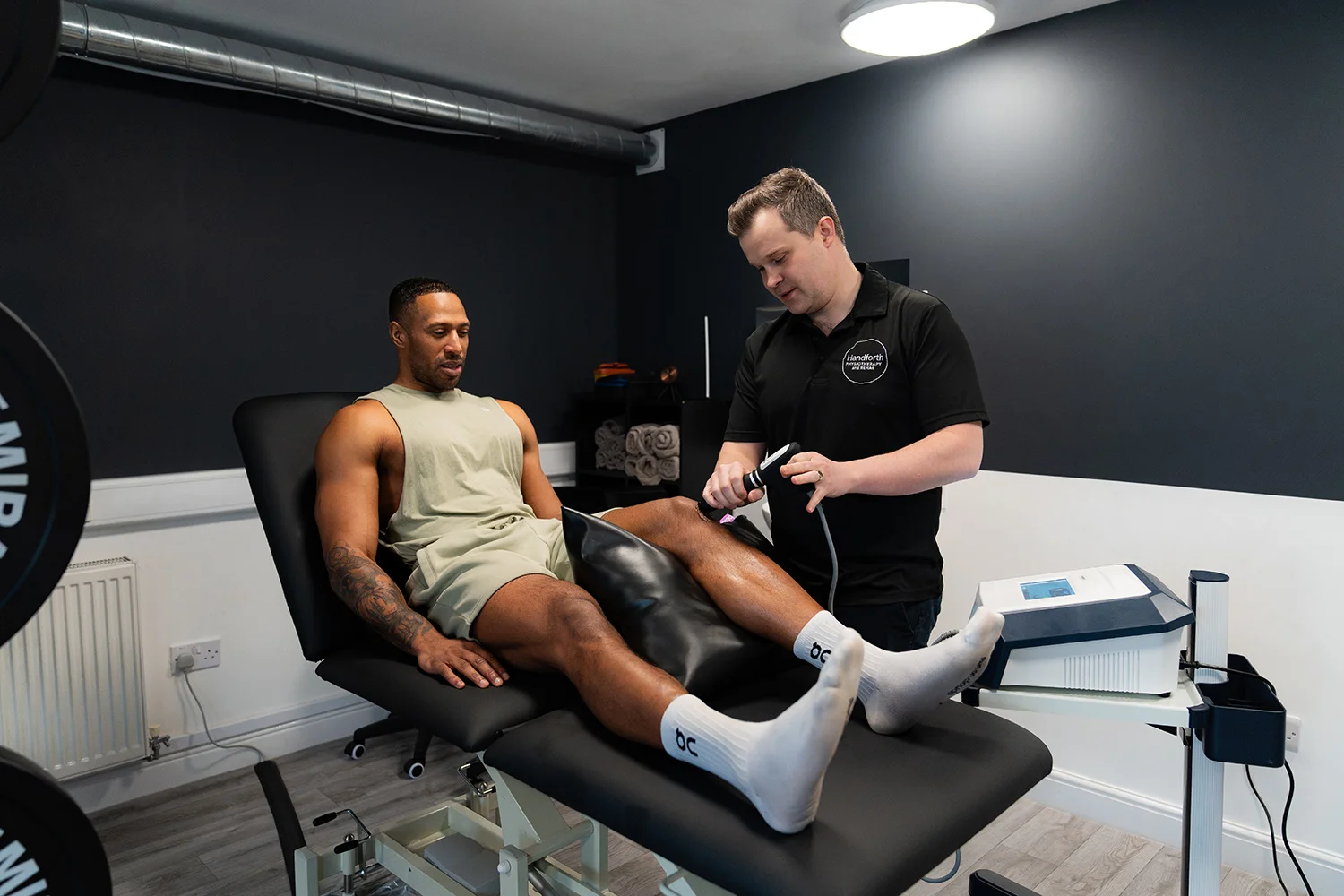
At Handforth Physiotherapy and Rehab, we offer Extracorporeal Shockwave Therapy (ESWT), a non-invasive treatment for persistent soft-tissue pain that supports the body’s own repair process.
This treatment delivers targeted acoustic waves deep into the affected tissue to stimulate blood flow, encourage tissue repair and reduce chronic irritation.
Shockwave Therapy (ESWT) is delivered at our clinic on Wilmslow Road in Handforth, serving patients across Handforth, Wilmslow, Alderley Edge and Cheadle.
Patients also travel from Bramhall and Cheadle Hulme for ESWT, particularly those who’ve been told by another provider that they’re not suitable for further injections or surgery and want a non-surgical option closer to home.
ESWT is a safe, non-surgical alternative designed for chronic musculoskeletal conditions that haven’t responded to standard treatments.
Common applications include: plantar fasciitis, Achilles tendinopathy, tennis elbow, rotator cuff tendinopathy, heel spurs and other stubborn soft-tissue injuries.
If you are experiencing one of these conditions, you may also find it helpful to read our condition guides on Ankle Injury, Shoulder Pain, Elbow Pain and Sports Injuries for more on assessment and treatment options.
Call, email or use our contact form to arrange an initial assessment. Because ESWT isn’t suitable for every condition or every stage of an injury, we recommend a short conversation with the team beforehand so we can check it’s likely to be appropriate before you book.
Your first visit includes a full assessment of the affected area, a discussion of your symptoms and previous treatment, and an explanation of how ESWT works for your specific condition. If you’re a suitable candidate, treatment can often begin during this same appointment.
The handheld ESWT device is applied directly to the affected area, delivering a series of acoustic wave pulses. Most patients describe a firm tapping sensation rather than sharp pain, and your physiotherapist will adjust the intensity throughout to keep it within a tolerable range.
A typical course involves 4-6 sessions on average depending on your condition/treatment. It’s common to feel some soreness for a day or two after each session, similar to post-exercise muscle soreness, before symptoms begin to ease over the following days. Your physiotherapist will review your progress at each visit and advise whether to continue, adjust or complete the course, and may combine ESWT with other physiotherapy such as our Physiotherapy service or Sports / Deep Tissue Massage to support recovery between sessions.
Can’t find what your looking for?
This varies by condition and severity, but a typical course involves a number of sessions delivered at weekly intervals. Your physiotherapist will confirm an expected course length for your specific condition during your assessment.
A formal referral is not usually required to book an assessment, but if you have a referral or relevant scan/imaging results, please bring them along or send them ahead of your appointment so we can consider them as part of your assessment.
Most patients describe the sensation as a firm tapping or mild discomfort during treatment, which typically settles quickly afterwards. Your physiotherapist will adjust the intensity to a level you find tolerable and will explain what to expect before starting.
Handforth Physiotherapy is recognised by Bupa, WPA, AXA and Aviva. Cover for ESWT specifically depends on your individual policy, so we recommend checking with your insurer before booking. See our Pricing page for self-funded costs.
Shockwave therapy is most commonly used for plantar fasciitis, Achilles tendinopathy, tennis elbow (lateral epicondylitis), rotator cuff tendinopathy and heel spurs, particularly where symptoms have persisted for several months despite rest, stretching or standard physiotherapy.
Shockwave therapy isn’t suitable for everyone. It’s generally avoided during pregnancy, over areas with active infection or malignancy, in patients with certain bleeding or clotting disorders, and close to a pacemaker. Your physiotherapist will screen for these and other contraindications at your assessment before treatment begins.
Costs depend on the number of sessions your condition requires, which your physiotherapist will confirm at assessment. Current prices are listed on our Pricing page.
This varies by condition and how long you’ve had symptoms, and your physiotherapist will give you a personalised return-to-activity plan. Many patients continue light activity throughout their course, while more demanding training is usually reintroduced gradually as symptoms settle.
Read what our patients say on our Testimonials page, or find general answers on our FAQ page.
Can’t find what your looking for?
Let's Connect!
How Can We Help You Today?
We use cookies to personalise content and analyse traffic. You can choose which cookies to allow. Privacy Policy • Cookie Policy • Terms & Conditions • Google Privacy
We use cookies to help you navigate efficiently and perform certain functions. You can choose which categories to allow below. Cookies categorised as Necessary are always active.
We also use third-party cookies for analytics and advertising. These are only stored with your consent. You can update or withdraw consent at any time via the cookie icon at the bottom-left. This site operates under UK GDPR, the Data Protection Act 2018, and the Privacy and Electronic Communications Regulations (PECR). Cookie Policy • Privacy Policy
Necessary cookies are required for core site features including security, network management, and consent storage.
| Cookie | Duration | Description |
|---|---|---|
hmdg_cookie_consent | 180 days | Stores your cookie consent preferences. |
PHPSESSID | Session | WordPress session identifier. |
wordpress_logged_in_* | Session | WordPress login authentication. |
Functional cookies enable enhanced features such as live chat and remembering preferences.
| Cookie | Duration | Description |
|---|---|---|
wp-settings-* | 1 year | Stores user interface preferences. |
Analytics cookies help us understand visitor behaviour. Controls analytics_storage for Google Analytics 4.
| Cookie | Duration | Description |
|---|---|---|
_ga | 2 years | Google Analytics — distinguishes users. |
_ga_* | 2 years | Google Analytics 4 — session persistence. |
_gid | 24 hours | Google Analytics — distinguishes users. |
_gat | 1 minute | Google Analytics — throttles request rate. |
Performance cookies collect aggregate, anonymous data about site performance.
| Cookie | Duration | Description |
|---|---|---|
_gat_gtag_* | 1 minute | Google Tag Manager — rate throttle. |
Marketing cookies track visits to deliver relevant ads. Controls ad_storage, ad_user_data, and ad_personalization.
| Cookie | Duration | Description |
|---|---|---|
_gcl_au | 90 days | Google Ads — conversion tracking. |
_gcl_aw | 90 days | Google Ads — click attribution. |
_gac_* | 90 days | Google Ads — campaign information. |
IDE | 1 year | Google DoubleClick — ad targeting. |
Powered by HMDG • Cookie Policy