
Expert Support After Hip or Knee Replacement
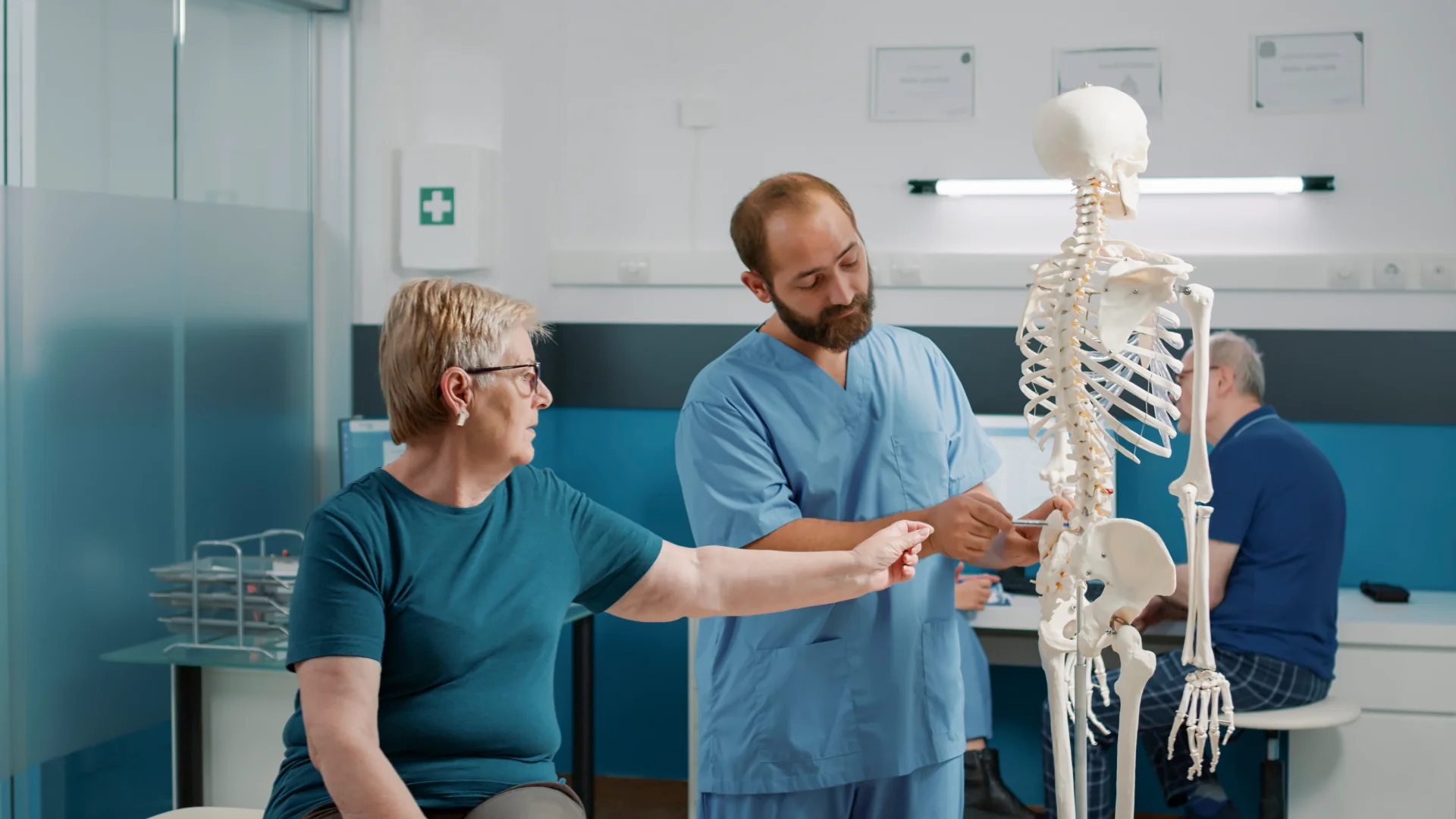
If you’ve recently had, or are due to have, a hip or knee replacement, this structured six-week programme gives you one-to-one support from a Chartered physiotherapist to rebuild movement, strength and confidence. It suits anyone who wants more consistent guidance than a generic exercise sheet, wherever your operation took place, delivered close to home at our Handforth clinic.
What does joint replacement rehabilitation include?
Your rehabilitation programme will be tailored to your operation, current mobility and personal goals. Treatment may include:
- Ongoing monitoring of your range of movement and strength
- A personalised rehabilitation and home exercise programme
- Progressive hip or knee strengthening
- Mobility and flexibility exercises
- Walking and gait rehabilitation
- Balance and stability exercises
- Stair practice
- Advice on pacing and returning to daily activities
- Support with confidence and independence
- Regular review and progression throughout the programme
Rehabilitation takes place in our dedicated clinic gym, allowing us to progress your exercises using appropriate resistance, weights and rehabilitation equipment.
Who this programme is for
This programme suits patients recovering from a total hip replacement, total knee replacement, partial (unicompartmental) knee replacement or revision surgery, whether the operation was carried out on the NHS or privately. It works just as well for someone starting rehabilitation from scratch as for someone returning to physiotherapy because hospital-led recovery has plateaued. It doesn’t replace the follow-up care provided by your surgical team, and where relevant your physiotherapist may also refer to information recorded on the National Joint Registry (NJR), which monitors outcomes of hip and knee replacement surgery across the UK.
Choose your six-week rehabilitation programme
One session per week
A structured option for patients who are confident completing exercises independently between appointments.
- Free Clinical Director consultation
- Six 45-minute rehabilitation sessions
- Ongoing monitoring of movement and strength
- Personalised home exercise programme
- Weekly review and progression
Two sessions per week
Our most popular option, providing more regular supervision and exercise progression.
- Free Clinical Director consultation
- Twelve 45-minute rehabilitation sessions
- More frequent monitoring of movement and strength
- Supervised mobility, balance and strengthening exercises
- Regular technique review and programme progression
Three sessions per week
Our highest-support option for patients who require intensive rehabilitation or prefer closely supervised exercise.
- Free Clinical Director consultation
- Eighteen 45-minute rehabilitation sessions
- Close monitoring of range of movement, strength and function
- Intensive, personalised rehabilitation
- Regular gait, balance and mobility work
- Maximum support to improve confidence and independence
Full pricing details for all our services are available if you would like to compare this programme with our other physiotherapy options.
What to Expect
Knowing what happens at each stage can make it easier to decide whether this programme is right for you.
Step 1: Book your free consultation
Call, email or use our contact form to arrange your free consultation with Richard Higgs. This usually takes place at our clinic on Wilmslow Road in Handforth and lasts approximately 30 minutes. Richard will ask about your surgery, your surgeon’s guidance and any precautions you’ve been given, and will confirm whether clinic-based rehabilitation is appropriate for you at this stage.
Step 2: Choose your programme frequency
Based on your consultation, you’ll choose between one, two or three sessions a week for six weeks. There’s no need to decide before your consultation. Many patients find it helpful to discuss their goals with Richard first and let his recommendation guide their choice.
Step 3: Your first rehabilitation session
Your first session establishes a baseline: your current range of movement, strength, walking pattern and any specific concerns. This informs the personalised home exercise programme and in-clinic plan built around your goals, whether that’s returning to gardening, walking the dog, driving, or getting back on the golf course.
Step 4: Progressive weekly sessions
Each 45-minute session builds on the last. Your physiotherapist will progress your exercises, using the resistance equipment in our clinic gym, as your strength and confidence improve, and will adjust the plan if you experience swelling, pain or a setback.
Step 5: Finishing the programme and what comes next
At the end of your six weeks, your physiotherapist will review your progress against your starting point and discuss whether further input is needed. Many patients choose to continue building on their progress with our Physio Led Personal Training or Pilates sessions once the structured programme ends.
Why is physiotherapy important after a hip or knee replacement?
Physiotherapy can help you regain movement, improve strength and return to everyday activities following joint replacement surgery. A structured rehabilitation programme also allows your progress to be monitored over time. Exercises can then be adjusted according to your recovery rather than relying on a generic exercise sheet. Common rehabilitation goals include:
- Improving knee or hip movement
- Reducing stiffness
- Rebuilding muscle strength
- Improving walking quality
- Managing stairs more confidently
- Returning to work, hobbies and exercise
- Reducing reliance on walking aids
- Improving balance and independence
While every patient’s recovery is individual and outcomes cannot be guaranteed, our aim throughout this six-week programme is measurable progress against your own baseline in range of movement, strength, walking ability and confidence.
When should rehabilitation begin?
The timing of physiotherapy will depend on your surgery, hospital guidance and individual recovery. Some patients begin private physiotherapy shortly after discharge, while others start once their hospital rehabilitation has finished. We can also support patients who feel their recovery has slowed or who want more guidance progressing their exercises. Your free Clinical Director consultation will help determine the most appropriate level of support for you.
Hip replacement rehabilitation
Hip replacement rehabilitation commonly focuses on:
- Improving hip movement
- Strengthening the hip and surrounding muscles
- Improving walking pattern
- Progressing away from walking aids
- Improving balance and stability
- Returning to stairs, driving, work and exercise
Your programme will be adapted to your surgeon’s guidance, surgical approach and stage of recovery.
If you are recovering from hip surgery more generally, our Hip Pain condition page has further information on assessment and treatment options.
Knee replacement rehabilitation
Knee replacement rehabilitation commonly focuses on:
- Improving knee bending and straightening
- Reducing stiffness
- Rebuilding quadriceps and leg strength
- Improving walking and stair ability
- Managing swelling
- Increasing confidence with everyday activities
We will monitor your knee movement and strength throughout your six-week programme and progress your exercises accordingly.
See our Knee Pain condition page for more on how we assess and treat knee problems generally.
Joint replacement physiotherapy near Wilmslow
Handforth Physiotherapy and Rehab is conveniently located in Handforth, close to Wilmslow, Alderley Edge and Cheadle. Our clinic includes a dedicated rehabilitation gym and treatment rooms, allowing patients to complete both clinical assessment and progressive exercise rehabilitation in one location.
Once you have completed your structured six-week programme, many patients choose to continue building strength and confidence with our Physio Led Personal Training or Pilates sessions, both supervised by our physiotherapy team to help maintain the progress you’ve made.
Many of our joint replacement patients travel from Cheadle Hulme, Bramhall and Poynton, as well as Handforth itself, valuing the chance to complete assessment and hands-on rehabilitation in one clinic rather than travelling between hospital physiotherapy and a separate gym.
Your Questions, Answered.
Can’t find what your looking for?
When can I start the rehabilitation programme?
Rehabilitation usually begins soon after hip or knee replacement surgery, once you have been discharged and are medically stable. Hospitals commonly encourage patients to begin walking and basic physiotherapy exercises shortly after surgery.
For this six-week programme, many patients may be ready to start around two to three weeks after surgery, although the right time will depend on:
- Your surgeon’s instructions
- Wound healing
- Pain and swelling
- Your mobility and general health
- Any post-operative restrictions or precautions
You may also start later if you have completed NHS rehabilitation but feel you need further support with strength, movement, walking or confidence. The free Clinical Director consultation will be used to confirm whether the programme is suitable and when it should begin.
Do I need permission from my surgeon?
A formal referral is not usually required, but you must follow any advice, precautions or restrictions provided by your surgeon or hospital team.
Please tell us about any complications, wound concerns, weight-bearing restrictions or specific hip precautions before starting. Some patients are advised to follow movement precautions for several weeks after hip replacement surgery.
What happens during the free consultation?
The free consultation with the Clinical Director is separate from your six-week rehabilitation sessions.
It is used to:
- Discuss your operation and recovery so far
- Review your hospital or surgeon’s instructions
- Identify your rehabilitation goals
- Discuss the most appropriate programme frequency
- Check that you are suitable to begin clinic-based rehabilitation
The consultation has a usual value of £75 but is provided free of charge when considering one of the six-week programmes.
Are the sessions one-to-one?
Yes. All rehabilitation sessions are delivered one-to-one and last 45 minutes.
Will my progress be measured?
Yes. Your physiotherapist will monitor your progress throughout the programme, including relevant measures of:
- Hip or knee range of movement
- Muscle strength
- Walking ability
- Balance
- Stair function
- Confidence and independence
Your rehabilitation programme will be adapted according to your progress, symptoms and goals.
Do I have to complete all sessions within six weeks?
Yes. The programme is designed as a structured six-week course, and all sessions must normally be completed within the six-week period.
A short extension may be considered only where sessions cannot be completed because of a documented medical issue, post-operative complication or hospital appointment. Extensions are at the clinic’s discretion and are not guaranteed.
What are the programme terms and conditions?
The following terms apply to all Joint Replacement Rehabilitation Programmes:
- The full programme fee must be paid in advance.
- The free Clinical Director consultation has no cash value and cannot be exchanged for another service.
- The consultation does not count as one of the 6, 12 or 18 rehabilitation sessions.
- Sessions are allocated to the named patient only and cannot be transferred or shared.
- Sessions cannot be exchanged for physiotherapy, massage, Pilates or any other clinic service.
- All sessions must normally be used within the six-week programme period.
- Missed, cancelled or rescheduled appointments remain subject to the clinic’s 24-hour cancellation policy.
- Appointments cancelled with less than 24 hours’ notice, or not attended, will be deducted from the programme.
- Unused sessions are non-refundable.
- Partial refunds are not available once the programme has started.
- Programme frequency and appointment availability are subject to clinician and clinic availability.
- Specific appointment times cannot be guaranteed for the full six weeks.
- Patients must disclose any surgical complications, restrictions, infections, wound concerns or changes in health.
- The clinic may pause or discontinue rehabilitation if treatment is considered unsafe or if medical review is required.
- Outcomes cannot be guaranteed, as recovery varies between patients.
- The programme does not replace medical or surgical follow-up.
What happens if I become unwell or develop a complication?
Contact the clinic as soon as possible. Your programme may need to be paused while you seek advice from your GP, surgical team or another appropriate healthcare professional.
You should seek urgent medical advice for symptoms such as worsening wound redness or discharge, fever, sudden significant swelling, unexplained calf pain, chest pain or shortness of breath. Blood clots and wound infections are recognised potential complications following joint replacement surgery.
Can I change to a different programme after starting?
Programme changes are not guaranteed. Moving to a higher-frequency programme may be possible by paying the difference, subject to clinical suitability and appointment availability.
Moving to a lower-frequency programme or receiving a refund for unused sessions will not normally be permitted once the programme has begun.
Can I claim through private medical insurance?
These are prepaid rehabilitation programmes and may not be accepted by private medical insurers. Patients wishing to claim through insurance should check with their insurer before purchasing. The patient remains responsible for the full programme fee.
Can’t find what your looking for?