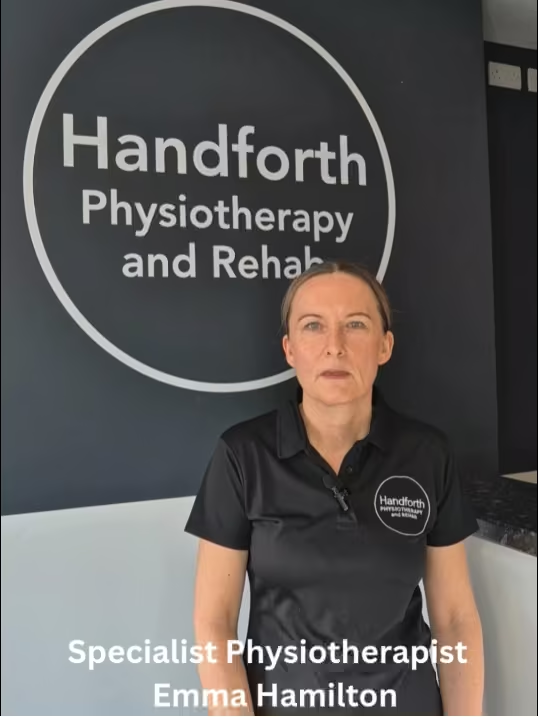
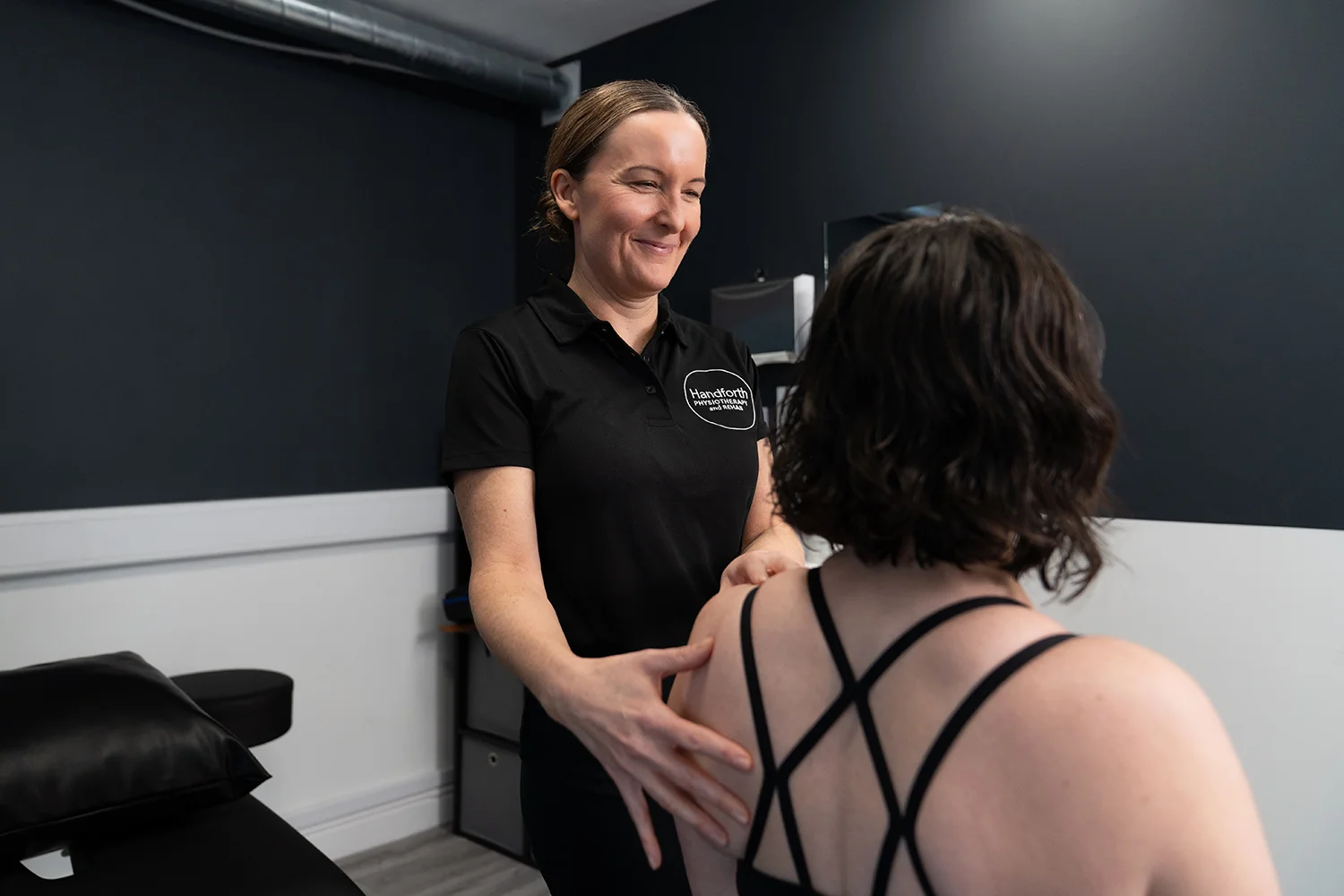
Breast care physiotherapy at Handforth Physiotherapy and Rehab supports anyone recovering from breast cancer surgery, treatment or related conditions, whether that’s a few weeks after your operation or several years on. Appointments are led by a chartered, HCPC-registered physiotherapist from our clinic in Handforth, and we see patients from across Wilmslow, Cheadle and Alderley Edge, with no GP referral required to get started.
Recovering from breast surgery, cancer treatment, or related conditions can feel overwhelming, but the right physiotherapy can make a significant difference to how you move, feel and function day to day.
At Handforth Physiotherapy and Rehab, we provide specialist breast cancer physiotherapy tailored to your stage of recovery, your symptoms, and your goals.
Our approach combines clinical expertise with genuinely personalised care, helping you regain confidence in your body safely and effectively. All appointments are conducted with full confidentiality, in a private treatment room, and our team is DBS-checked as standard practice for anyone providing this kind of hands-on, personal care.
Breast cancer treatment can affect more than just the surgical site. Many people experience ongoing physical symptoms that impact daily life, exercise and overall wellbeing.
Physiotherapy can help to:
Early treatment often leads to better outcomes, but physiotherapy can be effective at any stage of recovery, even months or years after treatment.
This approach is consistent with guidance from NICE (including quality standards on breast cancer care), Macmillan Cancer Support, and the Association of Chartered Physiotherapists in Oncology and Palliative Care (ACPOPC), all of which recognise physiotherapy and rehabilitation as an important part of recovery after breast cancer treatment.
We support patients with a wide range of post-treatment symptoms and complications, including:
If you are unsure whether physiotherapy is appropriate for your symptoms, we are always happy to advise.
If you’re also managing pelvic floor or continence changes related to treatment or menopause, our Women’s Health Physiotherapy service works alongside breast care physiotherapy to support your wider recovery.
Your initial assessment is a 60-minute appointment where we take the time to fully understand your history, treatment journey and current concerns.
Treatment may include:
All treatment plans are tailored to you, there is no one-size-fits-all approach.
Starting physiotherapy after a breast cancer diagnosis or surgery can feel like one more thing to navigate on top of a lot else, so here’s what actually happens, step by step.
1. Booking. You can book directly online or by contacting us, whether you’re currently in treatment, recently out of surgery, or years past treatment. No referral from your GP, breast care nurse or consultant is required, though we’re always happy to liaise with your wider care team with your consent.
2. Your initial assessment. This is a 60-minute appointment in a private treatment room, where your physiotherapist takes a full history of your diagnosis, treatment and surgery, current symptoms, and what matters most to you, whether that’s shoulder movement, returning to exercise, or managing swelling.
3. A tailored treatment plan. Based on your assessment, your physiotherapist agrees a plan with you, which may include manual therapy, guided exercises, scar management or lymphoedema advice, explained in plain terms before anything begins.
4. Ongoing sessions. (Typical number and length of follow-up sessions to be confirmed with the clinic, as this varies with the individual’s stage of recovery and symptoms.) Your plan is reviewed regularly and adjusted as your symptoms and confidence change.
5. Moving forward. Some clients need only a handful of sessions, others benefit from ongoing support over a longer period, particularly alongside radiotherapy or where lymphoedema needs monitoring. Your physiotherapist will always be honest about what they think will help, rather than extending treatment unnecessarily.
Our breast care physiotherapy service is delivered by experienced clinicians with a strong background in both NHS and private healthcare settings.
Our lead clinician, Richard Higgs, is a Chartered, HCPC-registered physiotherapist and Clinical Director of Handforth Physiotherapy and Rehab (additional specific NHS breast/oncology unit experience and any post-graduate qualifications, to confirm exact details with Richard for named attribution).
We combine evidence-based treatment with a compassionate, supportive approach, recognising that recovery is not just physical, but also emotional.
You will be listened to, understood and guided at a pace that feels right for you.
What our clients say: See our Testimonials page and Doctify reviews.
Physiotherapy can begin:
Scar tissue and movement restrictions can continue to develop for 6 to 12 weeks after surgery, and without the right input, these changes can become more difficult to address over time.
Starting earlier can help prevent long-term limitations, but it is never too late to benefit from treatment.
We’re conveniently located in Handforth, with easy access from Wilmslow, Cheadle and Cheadle Hulme. Many patients also travel in from Alderley Edge, Bramhall and Poynton.
Our clinic offers a calm, private and professional environment, with flexible appointments available throughout the week.
We also welcome patients from Altrincham, Hale and Bowdon, many of whom prefer a private, specialist appointment away from a hospital setting once their acute treatment is complete.
If you are experiencing pain, stiffness or movement difficulties following breast cancer treatment, we are here to help. You can book online or contact our team to discuss whether this service is right for you.
If you have more questions before booking, our Contact Us page has our full details, or you can start with our general Physiotherapy service page to understand what a first appointment involves.
Can’t find what your looking for?
No, you can book directly with us without a GP or consultant referral.
Yes. Treatment is adapted to your stage of recovery and guided by clinical evidence to ensure it is safe and appropriate.
Physiotherapy can play an important role in managing swelling, improving movement and supporting overall function. We can also advise on onward referral if specialist lymphoedema services are required.
This depends on your symptoms and goals. Some patients need only a few sessions, while others benefit from a longer rehabilitation plan.
Not usually, though there can be some discomfort as tight scar tissue or cording is gently released. Your physiotherapist will always work within what’s comfortable for you and adjust their approach if anything feels too much.
In many cases, yes. Physiotherapy can often continue alongside active cancer treatment, with your programme adapted around fatigue, skin changes from radiotherapy, and how you’re feeling day to day. We’ll always ask about your current treatment so we can plan appropriately.
We are recognised by Bupa, WPA, AXA and Aviva. Cover for this type of physiotherapy varies by policy, so check directly with your insurer or ask our team when you book.
No, it’s not too late. While starting earlier can help prevent some issues becoming established, physiotherapy can still help with shoulder stiffness, scar tightness or swelling months or even years after treatment finished.
Yes, this may be possible. Our Physiotherapy Home Visits service is available for patients who find it difficult to attend the clinic in person, and our team can advise whether this is suitable in your circumstances.
You can read verified patient reviews of Handforth Physiotherapy and Rehab on our Testimonials page and on our Doctify profile.
Can’t find what your looking for?
Let's Connect!
How Can We Help You Today?
We use cookies to personalise content and analyse traffic. You can choose which cookies to allow. Privacy Policy • Cookie Policy • Terms & Conditions • Google Privacy
We use cookies to help you navigate efficiently and perform certain functions. You can choose which categories to allow below. Cookies categorised as Necessary are always active.
We also use third-party cookies for analytics and advertising. These are only stored with your consent. You can update or withdraw consent at any time via the cookie icon at the bottom-left. This site operates under UK GDPR, the Data Protection Act 2018, and the Privacy and Electronic Communications Regulations (PECR). Cookie Policy • Privacy Policy
Necessary cookies are required for core site features including security, network management, and consent storage.
| Cookie | Duration | Description |
|---|---|---|
hmdg_cookie_consent | 180 days | Stores your cookie consent preferences. |
PHPSESSID | Session | WordPress session identifier. |
wordpress_logged_in_* | Session | WordPress login authentication. |
Functional cookies enable enhanced features such as live chat and remembering preferences.
| Cookie | Duration | Description |
|---|---|---|
wp-settings-* | 1 year | Stores user interface preferences. |
Analytics cookies help us understand visitor behaviour. Controls analytics_storage for Google Analytics 4.
| Cookie | Duration | Description |
|---|---|---|
_ga | 2 years | Google Analytics — distinguishes users. |
_ga_* | 2 years | Google Analytics 4 — session persistence. |
_gid | 24 hours | Google Analytics — distinguishes users. |
_gat | 1 minute | Google Analytics — throttles request rate. |
Performance cookies collect aggregate, anonymous data about site performance.
| Cookie | Duration | Description |
|---|---|---|
_gat_gtag_* | 1 minute | Google Tag Manager — rate throttle. |
Marketing cookies track visits to deliver relevant ads. Controls ad_storage, ad_user_data, and ad_personalization.
| Cookie | Duration | Description |
|---|---|---|
_gcl_au | 90 days | Google Ads — conversion tracking. |
_gcl_aw | 90 days | Google Ads — click attribution. |
_gac_* | 90 days | Google Ads — campaign information. |
IDE | 1 year | Google DoubleClick — ad targeting. |
Powered by HMDG • Cookie Policy